Hussaini Umar
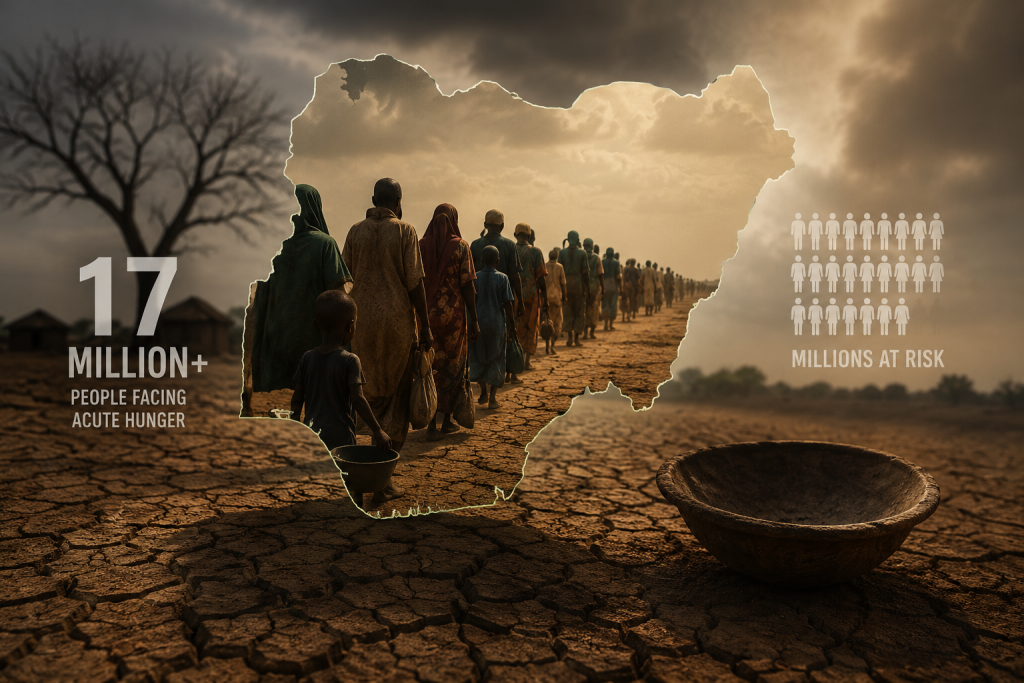
Northern Nigeria is confronting its most severe hunger crisis in nearly a decade, with conflict, displacement, economic hardship and shrinking humanitarian funding pushing millions of people toward acute food insecurity, according to the United Nations World Food Programme (WFP).
The UN agency said more than 17 million people across nine conflict-affected northern states are currently experiencing crisis, emergency or catastrophic levels of hunger, marking a sharp deterioration from previous projections. The worsening conditions coincide with Nigeria’s annual lean season—the period between planting and harvest when food reserves are typically exhausted and vulnerable households struggle to meet basic nutritional needs.
The WFP attributed the escalating crisis to persistent insecurity across northern Nigeria, where attacks by insurgent groups in the North-East and armed bandits in parts of the North-West and North-Central continue to force families from their homes, disrupt farming activities and restrict humanitarian access.
“When people lose access to food, the risks of displacement, exploitation and instability increase,” said WFP Regional Director for West and Central Africa, Kinday Samba, warning that expanding violence is preventing thousands of farmers from cultivating their land.
Borno Remains the Epicentre
Among the hardest-hit states is Borno, where more than three million people are experiencing acute food insecurity. Of that number, over 750,000 people are reported to be facing severe hunger conditions requiring urgent humanitarian intervention.
For more than 15 years, Borno has remained the epicentre of Nigeria’s insurgency, with repeated attacks destroying livelihoods, limiting agricultural production and forcing millions into displacement camps or host communities. Humanitarian agencies warn that the prolonged conflict has weakened communities’ ability to recover, making them increasingly vulnerable to food shortages.
Funding Cuts Threaten Humanitarian Response
Despite the growing humanitarian emergency, aid organisations say they are struggling to sustain food assistance because of significant funding shortfalls.
According to the WFP, the agency can currently support fewer than half of the 1.3 million people it assisted during the previous year across Borno, Adamawa and Yobe states, even though 6.2 million people in those three states alone now require food assistance.
The organisation estimates it urgently needs 89 million dollars over the next six months to continue providing food, nutrition and logistics support across northern Nigeria. Without additional funding, humanitarian operations could be further scaled back, leaving millions without life-saving assistance.
Conflict and Economic Pressures Intensify Food Insecurity
Beyond insecurity, the food crisis has been aggravated by soaring food prices, inflation, climate-related shocks and declining household incomes.
Many farming communities have abandoned agricultural activities because of repeated attacks and kidnappings, while rising transportation costs and disruptions to supply chains have driven up the prices of staple foods across northern Nigeria.
Analysts say the combined effects of insecurity and economic hardship have reduced household purchasing power, forcing many families to skip meals, reduce dietary diversity or rely on humanitarian assistance for survival.
The WFP has consistently warned that food insecurity and insecurity reinforce each other. Communities facing prolonged hunger are often exposed to greater risks of displacement, exploitation and social instability, creating conditions that further undermine peace and development.
Humanitarian Concerns Extend Beyond Food
The hunger crisis is also raising concerns about malnutrition, particularly among children and pregnant or nursing mothers.
Humanitarian organisations have warned that reduced funding has already forced the scaling back of nutrition programmes in several communities, increasing the risk of severe acute malnutrition among vulnerable children.
The deterioration comes at a time when humanitarian needs across West and Central Africa continue to rise, stretching available resources and limiting the capacity of aid agencies to respond effectively.
Call for Coordinated Action
The UN is urging the Nigerian government, development partners and international donors to strengthen investments in emergency food assistance while addressing the root causes of the crisis, including insecurity, displacement, rural poverty and barriers to agricultural production.
Experts also stress the need for improved security in farming communities, expanded support for climate-resilient agriculture and long-term investments in rural livelihoods to reduce dependence on humanitarian aid.
Without sustained intervention, humanitarian agencies warn that northern Nigeria’s food security situation could deteriorate further before the next harvest, placing millions more people at risk of hunger and malnutrition.
Source: Adapted from reporting by BusinessDay, with additional reporting and background from Reuters and the United Nations World Food Programme (WFP).