By Hussaini Umar
In corporate slide decks presented at international tech summits, the story of artificial intelligence in Northern Nigeria is painted in glowing, utopian strokes.
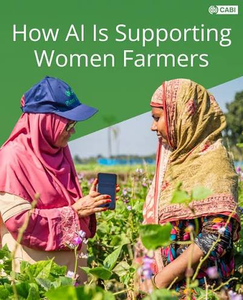
A prime example is the celebrated deployment of localized digital advisory tools like FarmerChat across the Arewa region. In Kano State alone, where the platform has engaged over 19,000 smallholder farmers, the integration of a Hausa Large Language Model (LLM) is hailed as a historic victory for digital inclusion.
The narrative is undeniably compelling: by enabling farmers to ask complex agronomic questions via WhatsApp voice notes in their native Hausa, the app breaks down traditional literacy barriers. It delivers automated, real-time advice on pest management and crop cycles, building unprecedented communal trust. On paper, it is the ultimate proof that advanced technology can be democratized to ensure no rural worker is left behind.
But behind this sleek digital interface lies a stark, unexamined infrastructure reality. While tech executives celebrate the “magic” of an AI that seamlessly understands northern dialects, an investigative audit into the supply chain of these local language models reveals a deeply asymmetric, invisible labor market.
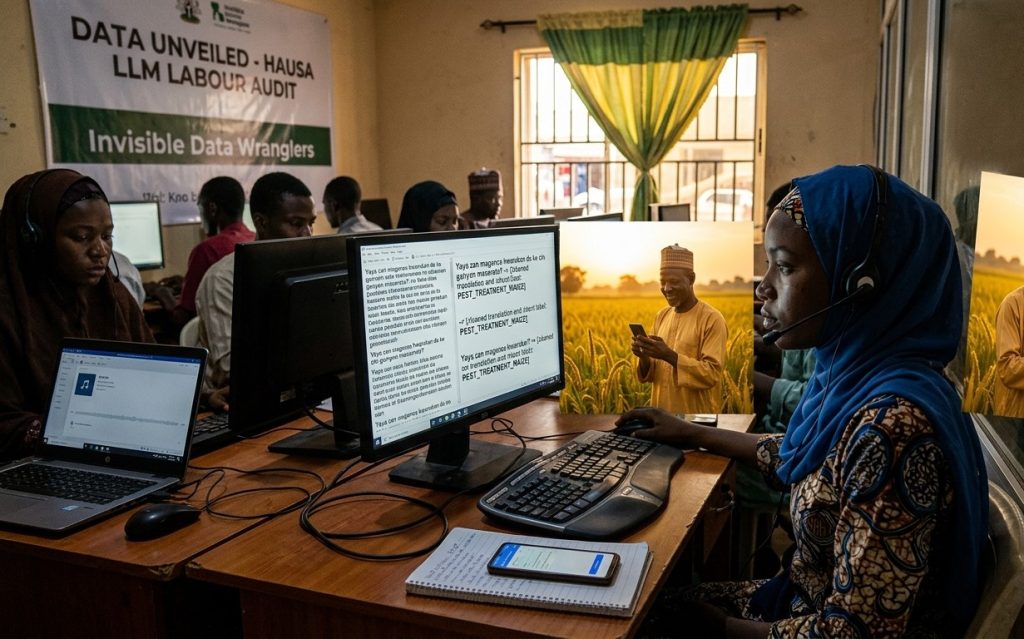
The seamless conversational accuracy experienced by a farmer in Gaya or Danbatta is not merely the product of silicon valley code it is built on the backs of an unrecognized class of local workers: The Invisible Data Wranglers.
Inside the Digital Sweatshops of the North
For a Large Language Model to accurately process a query like “Yaya zan magance kwarukan da ke cin ganyen masarata?” (How do I treat insects eating my maize leaves?), it must first ingest millions of data points of clean, grammatically synchronized Hausa text.
Raw text scraped from the internet is notoriously messy, full of localized slang, shorthand, and structural inconsistencies. To make this data readable for neural networks, it requires massive human intervention a process known as data labeling, Reinforcement Learning from Human Feedback (RLHF), and token normalization.
In modest computing hubs, rented apartments, and hidden co-working spaces across Kano, Zaria, and Kaduna, hundreds of young northern university and polytechnic graduates are quietly operating as data annotators.
They sit for ten to twelve hours a day, staring at spreadsheets, listening to fragmented audio files, and manually correcting machine translations for foreign tech sub-contractors. They are the human filters cleaning the language data that feeds the global AI machinery.
Yet, despite their highly specialized linguistic expertise, these data wranglers occupy the lowest rung of the global digital economy. Paid via obscure third-party freelancing platforms or micro-work agencies, many earn pennies per completed batch of annotated sentences.
They work without job security, health benefits, or professional recognition. While global development organizations take credit for “inclusive innovations” at international briefings, the local workforce executing the technical groundwork remains entirely invisible
The Hausa LLM Mirage: Who Owns the Sovereign Voice?
The dependency on foreign proprietary platforms creates a profound data sovereignty problem that transforms local language integration into a structural mirage.
Many frontline digital advisory platforms deployed in Sub-Saharan Africa do not actually own or host the core AI architectures they utilize. Instead, they operate as software layers built over closed-source, Western corporate APIs predominantly relying on tech infrastructures like Microsoft Azure OpenAI or GPT-4 foundations to process user intents.
—————————————————-+
| THE EXTRACTION CYCLICAL TRAP |
+——————————————————————-+
| [Local Community Generates Raw Language & Agronomic Data] |
| ↓ |
| [Invisible Local Wranglers Clean & Label the Data for Pennies] |
| ↓ |
| [Foreign Corporate Cloud Centers Absorb Data into Core Models] |
| ↓ |
| [Local Initiatives Pay Dollar-Denominated Token Fees to Query It]|
+——————————————————————-+
This architecture means that every time a smallholder farmer in Kano sends an audio note to a local chatbot, that localized data is converted into tokens, securely encrypted in transit, and routed directly out of Nigeria into cloud data servers hosted in Europe or North America.
The deep irony is systemic: the cultural and linguistic wealth of Northern Nigeria is being mined to train foreign proprietary models, which are then rented back to local NGOs and state governments via expensive, dollar-denominated utility fees.
If the international funding for an advisory app dries up, or if the Naira-to-Dollar exchange rate experiences another volatile crash, the access to these “inclusive” tools vanishes instantly. The community is left with no local infrastructure, no hosted weights, and no sovereign control over the digital tools that have become central to their seasonal agricultural planning.
The Technical Token Disparity
The economic structure of modern generative AI penalizes non-Western languages through a technical architecture known as tokenization fragmenting.
| Metric | English Language Query | Hausa Language Query (Equivalent Meaning) |
| Input Sentence | “Apply fertilizer after the first rain.” | “A zuba taki bayan an yi ruwan sama na farko.” |
| Token Count | ~6 Tokens | ~18 to 22 Tokens (Due to sub-word splitting) |
| Relative Cost | Baseline ($1x) | Hyper-inflated (~3x to 4x cost multiplier) |
Because the foundational dictionary models used by major international tech firms are optimized primarily for Western alphabets, complex phrases in African languages are aggressively split into smaller, meaningless byte-level fragments during processing.
This technical bias means that processing a standard advisory message in Hausa consumes triple the computational token volume of an identical message in English. Local tech startups attempting to build home-grown advisory platforms are hit with a massive, hidden financial penalty just for operating in their native language.
Moving Past the Mirage Toward True Linguistic Sovereignty
If Northern Nigeria is to transition from an extraction zone for global tech data into a self-sustaining digital economy, the model for local language deployment must be fundamentally restructured.
+-------------------------------------------------------------------+
|             THE REFORMED ROADMAP TO LINGUISTIC AUTONOMY           |
+-------------------------------------------------------------------+
| A. DATA LOCALIZATION: Enforce NDPA cross-border data mandates.     |
| B. FAIR LABOR TARIFFS: Regulate minimum wages for data labelers.  |
| C. OPEN SOVEREIGN PUBLIC GOODS: Fund national models like N-ATLAS.|
+-------------------------------------------------------------------+
Regulating the Data Labor Market: The Ministry of Communications, Innovation and Digital Economy, alongside regional labor bodies, must establish clear minimum wage standards and digital safety protections for data annotators and content moderators operating within local tech ecosystems. If our youth are building the brains of global AI, they must be compensated as highly skilled technical engineers, not digital laborers.
Enforcing the NDPA on Infrastructure Layers: The Nigeria Data Protection Commission (NDPC) must look beyond the user-facing app and audit the background infrastructure of global advisory deployments. If local user location and audio data are being routinely shared with international third parties to train commercial neural assets, explicit, non-coerced consent must be obtained in transparent Hausa audio formats.
Mandating Open-Weights Public Goods: Rather than subsidizing continuous dollar outflows to foreign corporate API walls, state governments across the North must actively back open-source, national digital public goods such as the National Center for AI and Robotics’ (N-ATLAS) multilingual model initiative. By downloading, training, and running open-weights language models on regional, solar-powered servers, the Arewa community can ensure that agricultural advisory tools remain free, locally controlled, and immune to global economic shocks.
Language is indeed the bridge to digital inclusion. But unless we own the structural foundation of the bridge, and protect the local workers who build it piece by piece, our regional data will continue to enrich foreign tech empires, leaving Northern Nigeria dependent on a digital mirage.