Hussaini Umar
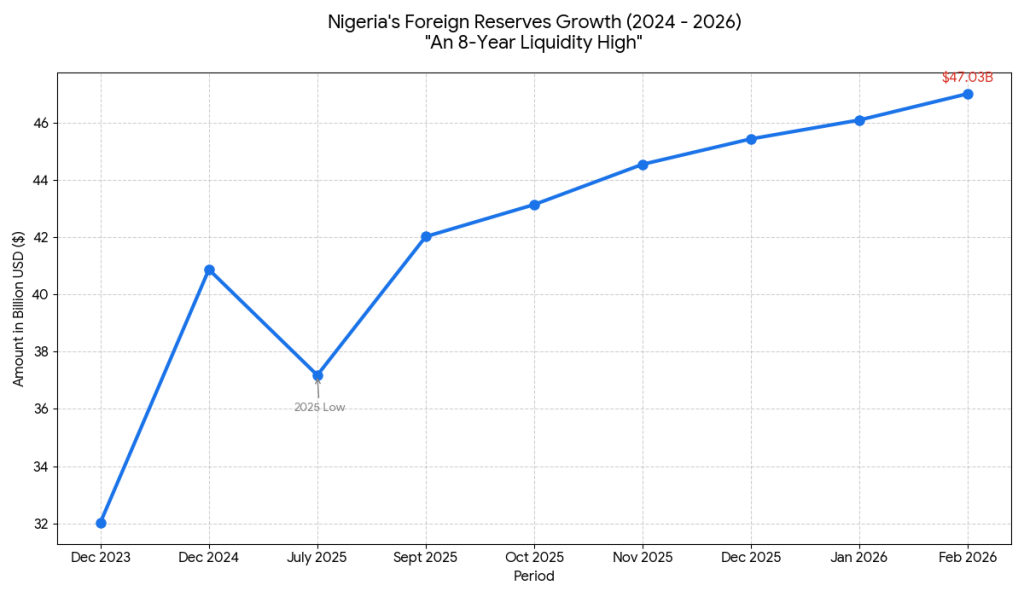
Nigeria’s external buffers have hit their highest level since 2018, providing the Central Bank of Nigeria (CBN) with a massive $47.025 billion shield against global economic shocks. This buildup of “financial ammunition” has triggered a fresh wave of confidence in the local currency, pushing the Naira to close at ₦1,351.02 at the official window.
The Data: A Multi-Year High
The steady accretion of foreign reserves is no longer just a trend; it is a structural shift. With a daily gain of over $112 million, the reserves are being fueled by a “triple-threat” of inflows: higher crude oil receipts, a surge in foreign portfolio investments, and improved corporate FX supply.
| Metric | Previous State | Current State | Change |
| Official Exchange Rate | ₦1,354.25/$1 | ₦1,351.02/$1 | +₦3.23 Appreciation |
| Foreign Reserves | $46.912 bn | $47.025 bn | +$112.94 million |
| Trading Band (Intraday) | ₦1,354 – ₦1,360 | ₦1,349 – ₦1,354 | Narrowing Volatility |
The 2018 Benchmark
Crossing the $47 billion mark is significant because it returns Nigeria to a pre-pandemic level of external liquidity. As a data journalist, I track this as the “Sovereign Safety Index.” When reserves are high:
- Speculative Pressure Drops: Traders are less likely to bet against the Naira when they know the CBN has the “firepower” to intervene.
- Import Confidence Rises: Manufacturers can plan for raw material imports with more predictable pricing.
- Credit Ratings Improve: International lenders view Nigeria as a lower-risk borrower, which can lead to cheaper foreign debt for infrastructure projects.
Market Dynamics: Beyond the Numbers
The intraday trading data revealed a “low” of ₦1,349.30, signaling that the market is testing even stronger levels for the Naira. This appreciation is being driven by “Real Money” flows—actual investments and export proceeds—rather than just Central Bank intervention.
The fact that the Naira is gaining while the CBN is simultaneously building reserves suggests a “Healthy Recovery.” In typical crisis years, the CBN had to burn reserves to save the Naira; in 2026, it is gathering reserves while the Naira saves itself.