Hussaini Umar
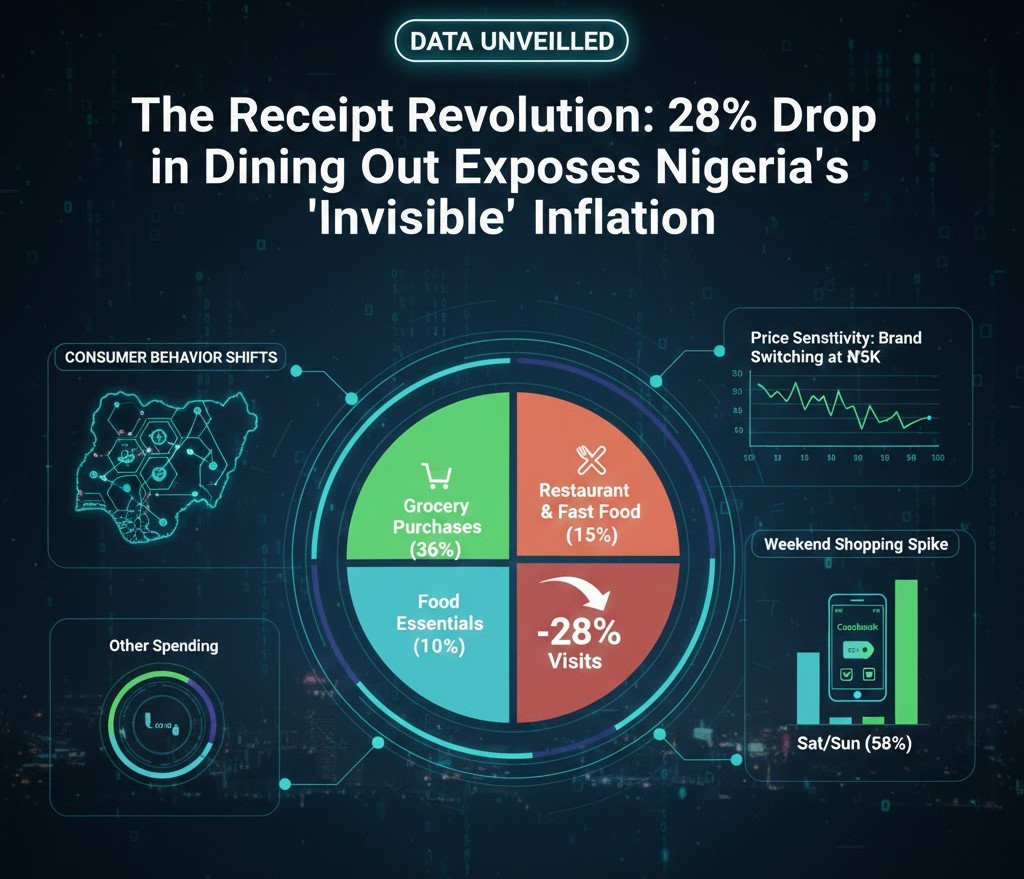
KANO, NIGERIA — New data from Shoppoint Rewards’ 2025 Invisible Economy Report has revealed a seismic shift in Nigerian consumer behavior. Despite official reports of easing inflation, household budgets have reached a breaking point, with discretionary spending on restaurants and fast food plummeting by 28 percent as families pivot to home cooking.
Why Receipts Tell a Better Story Than Banks
Traditional banking data shows where money goes, but receipt-level data reveals the “Substitution Strategy.” By analyzing 3 million verified receipts (representing up to ₦52 billion in spending), the report captures the granular trade-offs families are making:
- The ₦5,000 Threshold: 45% of shoppers switched to cheaper brands immediately after their usual household brand crossed the ₦5,000 price mark.
- The Saturday Surge: 58% of all grocery spending now happens on weekends, indicating a shift toward “bulk planning” to save on transport and time.
- Grocery Resilience: While eating out fell, grocery spending remained stable at 36% of total receipts (₦18.7 billion), proving that Nigerians are protecting “core consumption” at all costs.
The “Data Unveiled” Insight: Precision over Generalization
The report uses Conservative Ranges (₦45B – ₦52B). As an educator in business studies, you know this is a mark of high Methodological Rigour. It accounts for the vast regional differences in prices between hubs like Kano, Lagos, and Abuja.