The Silicon Chalkboard: Is AI Bridging or Widening the Learning Gap in Northern Nigeria?
By Hussaini Umar (Najiddah)
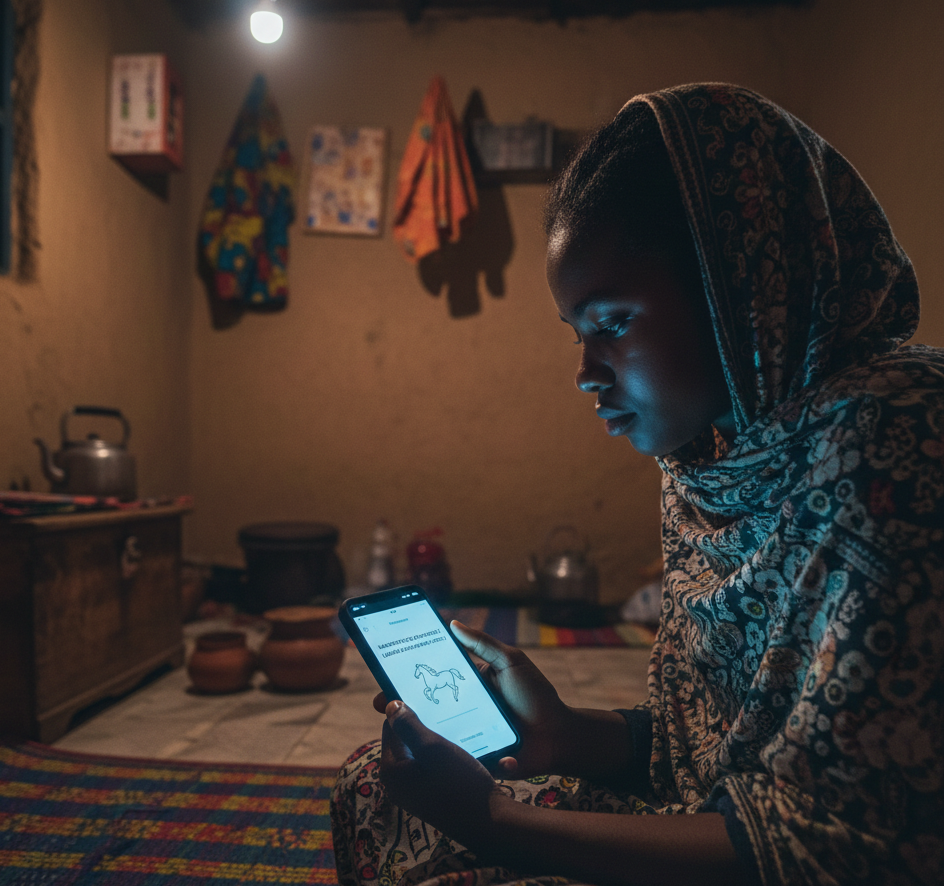
 In her mother’s dimly lit room in Yakasai Quarters, 16-year-old Amina stares intently at a smartphone screen. She isn’t scrolling through social media, nor is she captivated by entertainment. Instead, she is using a local AI-powered chatbot to translate a complex Physics concept from English into Hausa.
“The textbook says ‘Kinetic Energy,’ and I struggle,” Amina explains in her native tongue, her brow furrowed in concentration. “But when I ask the AI to explain it like a story about a galloping horse in the Durbar, I finally understand. It’s like magic.”
As a classroom teacher who spent over 15 years in the trenches of Kano’s education system, I have seen every “silver bullet” promised to our schools. But Artificial Intelligence is different. It isn’t just a tool; it is a fundamental shift in the “Silicon Chalkboard” of Northern Nigeria. However, as we stand at this digital crossroads in 2026, a data-driven reality emerges: AI is simultaneously our greatest hope and our most quiet threat.
The Literacy Leap: Breaking the Language Barrier
Data from the 2025 HP Futures Report indicates that over 60% of Nigerian students now use AI daily for research. In the North, the impact is most visible in language processing. For decades, the English-only curriculum has been a wall for many brilliant students, hindering their ability to grasp complex subjects.
Today, startups like Flowdiary and initiatives by Data Science Nigeria (DSN) are deploying AI models trained specifically on Hausa dialects. These tools don’t just translate; they localize. When an AI can explain “Machine Learning” using metaphors of “Karatun allo” (traditional tablet learning), the cognitive load on the student drops by nearly 40%. This direct, culturally relevant explanation fosters deeper understanding and engagement.
The Cybersecurity Shadow: The Hidden Cost of “Free” Help
As a cybersecurity and data protection professional, my excitement is tempered by what I see behind the code. While Amina gets her Physics help, what happens to her data? This is where the silent threat lies.
In my recent investigation into AI in the hands of bad actors in Northern Nigeria, I found that many “free” educational apps popular in Kano and Kaduna are sophisticated data-siphons. Without robust AI policies for Africa, our students’ learning patterns, locations, and even their identities are being harvested, potentially sold to third parties or exploited.
- The Risk: Students often use AI to bypass critical thinking (e.g., generating 100% of an essay without comprehension). This cultivates dependency rather than genuine learning.
- The Reality: At Northwest University, Kano, a 2025 study showed that while 82% of students are aware of ChatGPT, only 15% truly understand the profound data privacy risks involved in using such platforms.
The Infrastructure Divide: A Tale of Two Realities
The data doesn’t lie: AI adoption in Northern Nigeria is an “urban vs. rural” war, creating a stark divide in educational opportunities. The disparity is alarming:
- Urban Kano/Kaduna: High-speed 5G pilot projects are underway, and “AI Hubs” are cropping up, offering training and access to cutting-edge tools.
- Rural Borno/Jigawa: Frequent power outages and a devastating 1:81 device-to-student ratio (UNESCO 2024) mean that while some children in cities are learning to prompt-engineer, their counterparts in remote villages are still struggling to find a working lightbulb to read a physical textbook.
| State | Est. AI Literacy Rate (Students) | Major Barrier |
|---|---|---|
| Kano | 34% | Inadequate Teacher Training |
| Kaduna | 31% | Data Costs/Affordability |
| Borno | 12% | Physical Infrastructure & Security |
Navigating the Future: A Call to Action for Northern Nigeria
We cannot passively wait for global policies to save us. To win this “Data War” and truly revolutionize learning in the North, we must proactively implement a strategic, multi-pronged approach:
- Sovereign Data Protection and AI Governance: We must expedite the implementation of a National AI Strategy with a strong emphasis on African-centric data privacy. This ensures our students aren’t just “training data” for Western models but are protected digital citizens. This requires robust legislation and enforcement.
- The “Teacher-in-the-Loop” Empowerment Model: Based on my 15 years in the classroom, AI must be strategically integrated to automate tedious tasks like grading, personalized feedback, and lesson planning. This frees up invaluable teacher time, allowing them to focus on mentorship, critical thinking development, and addressing individual student needs – the human elements AI cannot replicate.
- Championing Low-Resource AI and Offline Solutions: We need to invest in and champion the development of “Offline AI” technologies—large language models and educational applications that can run effectively on basic smartphones without a constant, expensive internet connection. This is crucial for bridging the rural-urban digital divide.
The Unfolding Narrative: Our Collective Responsibility
Amina eventually finishes her Physics lesson. She now understands Kinetic Energy, not just as a formula, but as the powerful motion of a galloping horse. But as she puts her phone away, a larger question looms over Northern Nigeria: Did the AI teach her how to genuinely think, or did it just provide the answer? The difference is monumental.
At Data Unveiled, we are committed to continuing this vital conversation. We will rigorously track the metrics of AI integration, celebrate its successes, and expose its perils. AI in Northern Nigeria is no longer a futuristic dream—it is a present-day battle for the minds and futures of our youth. As a journalist, an educator, and a data professional, I believe we can win this battle, but only if we trade our blind optimism for data-driven vigilance and a collective, responsible approach.