Hussaini Umar
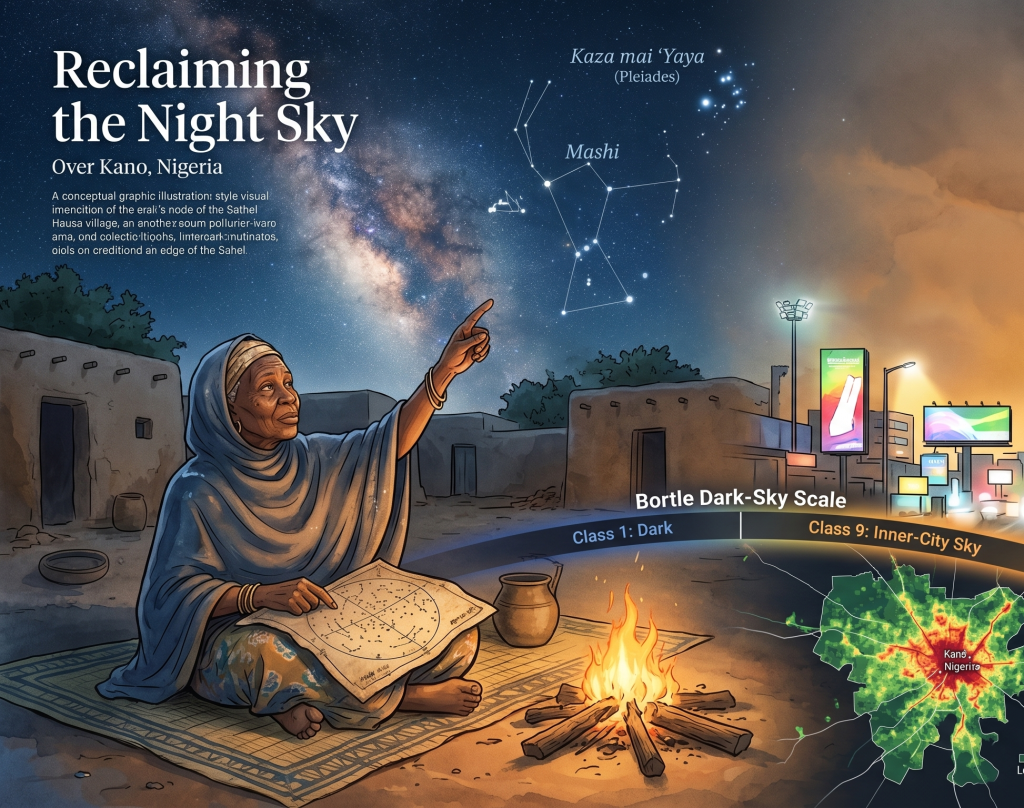
For centuries, when the sun dipped below the sweeping horizons of the Sahel, the ancient city of Kano entered a profound partnership with the cosmos. Under a canopy of pristine, velvety darkness, the night sky served as a living clock, a seasonal calendar, and a celestial ledger. Elders gathered on woven mats in open courtyards, pointing toward the glittering expanse to guide the next generation through the intricate tapestries of Hausa cosmic mythology and structural astronomy. Today, that connection is fading into a murky, artificial amber haze.
As Kano rapidly transforms into a hyper-urbanised commercial megacity, its nights are growing aggressively brighter. Unplanned urban sprawl, the unchecked installation of high-intensity commercial LED billboards, poorly shielded industrial security lights, and an influx of unstandardised street illumination are fueling a silent ecological and cultural crisis: light pollution.
An investigation into the changing nightscape of Kano State reveals a deeply troubling trend. The over-illumination of the city is not just an aesthetic or energy concern; it acts as an atmospheric barrier, blinding the region to its own sky. In doing so, it is permanently erasing centuries-old indigenous Hausa cosmological knowledge traditionally used for agricultural forecasting, navigation, and timekeeping while quietly locking young Northern Nigerians out of the burgeoning field of observational astrophysics.
he Astrophysics of a Vanishing Sky: The Bortle Scale of Kano
To understand how a city loses its stars, one must look through the lens of atmospheric physics. When artificial light is directed upward or reflected off the ground, it encounters molecules, dust particles, and aerosols in the lower atmosphere. This light scatters, creating an artificial glow that outshines the natural background radiation of the night sky a phenomenon known to astrophysicists as skyglow.
[Upward Artificial Light] + [Atmospheric Dust & Aerosols]
                           │
                           ▼
                 [Scattered Skyglow]
                           │
                           ▼
       [Blinding of Celestial Objects / Star Erasure]
To quantify this phenomenon, astronomers use the Bortle Dark-Sky Scale, a nine-level numeric scale that measures the observability of celestial objects. A Class 1 rating represents an absolute, pristine dark sky where the Milky Way casts a visible shadow on the ground. Class 9 represents an inner-city sky where the urban glow wipes out virtually all stars, leaving only the moon and the brightest planets visible.
Satellite data tracking artificial light emissions reveals that Kano’s metropolitan core has rapidly escalated to a Class 7 (Suburban/Urban Transition) and, in high-density commercial zones like the Kwari and Wapa markets, a Class 8/9 City Sky.
This rapid transition means that the limiting magnitude the measurement of how faint a star can be seen with the naked eye has plummeted. In rural parts of Kano State decades ago, a resident could easily spot stars with a magnitude of +6.5. Today, inside the Kano metropolis, anything fainter than a magnitude of +3.0 is completely swallowed by urban glare. The grand spiral of our galaxy, the Milky Way, which once stretched visibly across the Northern Nigerian sky as a brilliant silver pathway, is now completely invisible to millions of urban youths.
The Loss of Indigenous Hausa Cosmologies
The erasure of these stars is directly tied to the extinction of Hausa ethno-astronomy. Long before the advent of modern telescopes or satellite-based meteorological apps, the Hausa people possessed a highly sophisticated, empirical understanding of the motion of celestial bodies. This indigenous science was entirely dependent on an unpolluted view of the night sky.
Historically, constellations were not merely abstract shapes; they were vital functional toolkits. Consider the following key components of traditional Hausa cosmology:
1. Kaza mai ‘Yaya (The Hen and Her Chicks)
Known in Western astronomy as the Pleiades star cluster (M45), this tight grouping of stars was a cornerstone of Northern Nigerian agricultural science. Elders meticulously tracked its position relative to the eastern horizon just before dawn. When Kaza mai ‘Yaya appeared at a specific seasonal angle, it served as an empirical indicator that the dry season (Rani) was concluding and the clearing of farmlands for the planting season (Bazara) must immediately commence.
2. Mashi (The Spear) and Kaka (The Harvest)
The constellation of Orion, recognised locally through various traditional names including elements associated with hunting and protection (Mashi), served as a celestial clock for the seasonal life cycles of the Sahel. Its zenith placement directly predicted the arrival of the cold, dusty Harmattan winds (Dari) and signalled the exact timelines for harvesting grain crops without losing yield to sudden unseasonal weather changes.
3. Kandili (The Evening Star/Venus)
The brilliant shifts of Venus were used by long-distance caravan traders and nomadic herders across the North to calculate overnight travel times across wide terrains, ensuring safe passage between settlements before the scorching daytime heat set in.
+------------------------+--------------------------+---------------------------------+
| Hausa Traditional Name | Western Scientific Name  | Empirical Functional Utility    |
+------------------------+--------------------------+---------------------------------+
| Kaza mai 'Yaya         | Pleiades Cluster (M45)   | Agricultural planting timelines |
| Mashi / Orion Markers  | Orion Constellation      | Harvest cycles & Harmattan shifts|
| Kandili                | Planet Venus             | Nocturnal navigation & timing   |
+------------------------+--------------------------+---------------------------------+
When light pollution masks these celestial bodies, the physical library of this knowledge is destroyed. A rural grandfather living on the outskirts of Ungogo or Kumbotso can no longer step outside with his grandchildren to demonstrate these calculations because the horizon is choked by the permanent glowing dome of central Kano. As the stars disappear, the vocabulary of Hausa astronomy dies with them, replaced by a generational amnesia that severs the youth from their scientific heritage.
Reclaiming the Sky: A Gateway for African Astrophysics
The consequences extend far beyond cultural nostalgia; light pollution is a major barrier to modern academic advancement. As Nigeria seeks to expand its footprint in space science through the National Space Research and Development Agency (NASRDA), fostering a localised interest in astrophysics is vital.
For a student at Bayero University, Kano (BUK) or any young mind in the region, the spark of scientific curiosity almost always begins with simple, naked-eye observation. If a child grows up in an environment where they look up and see only a blank, gray-orange void, the conceptual leap to studying astrophysics, stellar evolution, or satellite technology feels entirely abstract and out of reach.
Moreover, the compounding effect of light pollution and atmospheric dust during the Harmattan season severely cripples local universities from setting up functional, low-cost optical observatories within urban campuses. Students are forced to rely purely on textbook theories or international data repositories, rather than engaging in hands-on, ground-based astronomical measurements. Reclaiming dark skies in designated zones is therefore an urgent educational necessity.
The Blueprint for an “Arewa Dark-Sky” Initiative
Kano does not have to turn off its lights to save its stars. The solution lies in Smart, Sustainable Dark-Sky Governance. To combat this creeping crisis, urban planners, environmental researchers, and local policymakers must collaborate on actionable, data-driven interventions:
- Shielding and Directional Lighting: The Kano State Urban Planning and Development Authority (KNUPDA) should institute building codes requiring all public, industrial, and commercial outdoor lighting fixtures to be “fully shielded.” By directing light downward to the ground where it is actually needed, rather than allowing it to spill sideways and upward into the atmosphere, skyglow can be reduced by up to 50% almost immediately.
- The Transition to Warmer LEDs: High-intensity blue-white LED lights, which have become popular in modern Kano renovations, are the primary drivers of severe atmospheric light scattering. Shifting municipal street lighting policies to use warm-spectrum LEDs (2700 Kelvin or lower) minimises scattering while still ensuring public safety and urban visibility.
- Designated Dark-Sky Educational Sanctuaries: Local authorities should proactively protect rural and semi-rural zones on the outskirts of Kano State, such as designated forest reserves or high-altitude areas, from heavy commercial lighting. These zones can serve as preserved “dark-sky sanctuaries” where schools, astronomy clubs, and researchers can retreat to observe the stars and document surviving indigenous astronomical oral histories.
The Moral Duty to Look Up
The night sky is the ultimate shared human heritage a free, open-access laboratory of wonder. For Northern Nigeria, it is an archive of our ancestors’ intellect, resilience, and scientific adaptability.
Watching the stars vanish over Kano is not an inevitable price of economic progress; it is a symptom of structural and environmental neglect. By taking measurable, deliberate steps to control light pollution, we can protect the ecology of our nights, preserve the rich legacy of Hausa cosmology, and ensure that the next generation of Northern Nigerian scientists can look up at the Sahelian sky, read its history, and find a clear, unhindered pathway to the stars.