By Hussaini Umar
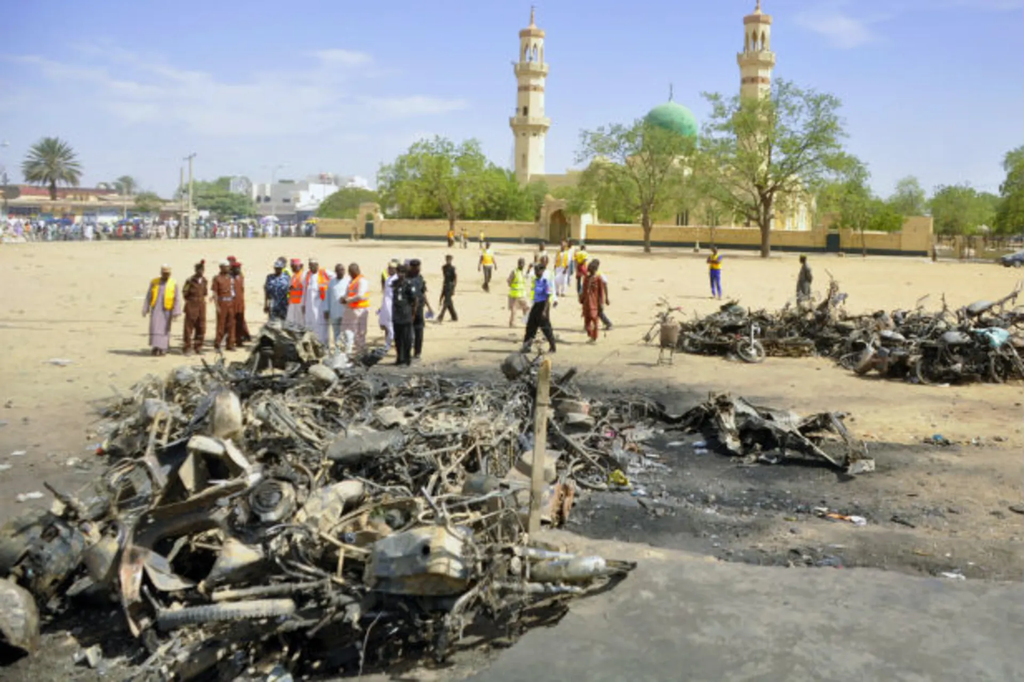
Eleven years after a suicide bombing tore through worshippers at Kano’s historic Central Mosque, Mallam Ayuba’s body bears no visible scars. Yet sleepless nights, persistent fear, and the vivid memory of a young man stepping toward a bomber continue to shape his life. His story lays bare the often-overlooked psychological toll of mass violence on survivors who emerge physically untouched.
The Friday That Changed Everything
On Friday, 28 November 2014, Mallam Ayuba arrived at Masallacin Sarki the grand mosque adjoining the Emir’s palace expecting an ordinary afternoon of devotion. Shortly before 2:00 p.m., as he sat among thousands of worshippers waiting for the Jumu’at congregational prayer to begin, he noticed an anomaly.
A gold-colored Toyota Sienna was forcing its way past the security barrier erected to protect the crowded grounds. A 50-kilogram jerrycan lodged beneath the vehicle’s front wheels was grinding against the pavement, slowing its advance. The driver pressed hard on the accelerator, determined to push forward.
“The jerrycan is under your car! Where are you trying to go?” Ayuba recalled shouting, attempting to draw the driver’s attention to the obstruction.
Beside Ayuba sat a young worshipper dressed in a new, light-green brocade shadda. Realizing the driver seemed oblivious to the commotion, the young man stood up from his prayer mat and walked toward the vehicle to offer directions.
Ayuba watched him reach the driver’s door. What happened next lasted only a fraction of a second, but it has echoed through his life for almost eleven years.
“As soon as he reached the driver’s door and started talking, I heard a terrible sound of an explosion,” Ayuba said.
Thick black smoke swallowed the courtyard. The young man in the green brocade vanished. Human remains were scattered across the concrete.
When Ayuba regained his bearings, he found himself lying on the roadside approximately 40 meters away, with no memory of how he got there. He checked his hands, his torso, and his clothes. There was no blood. There were no tears in his fabric. There was no physical wound.
Yet, as he looked around at the devastation, an overwhelming grief seized him. “I thanked God, but I started crying profusely because of the dead bodies I saw and the amputations young and old,” he recalled.
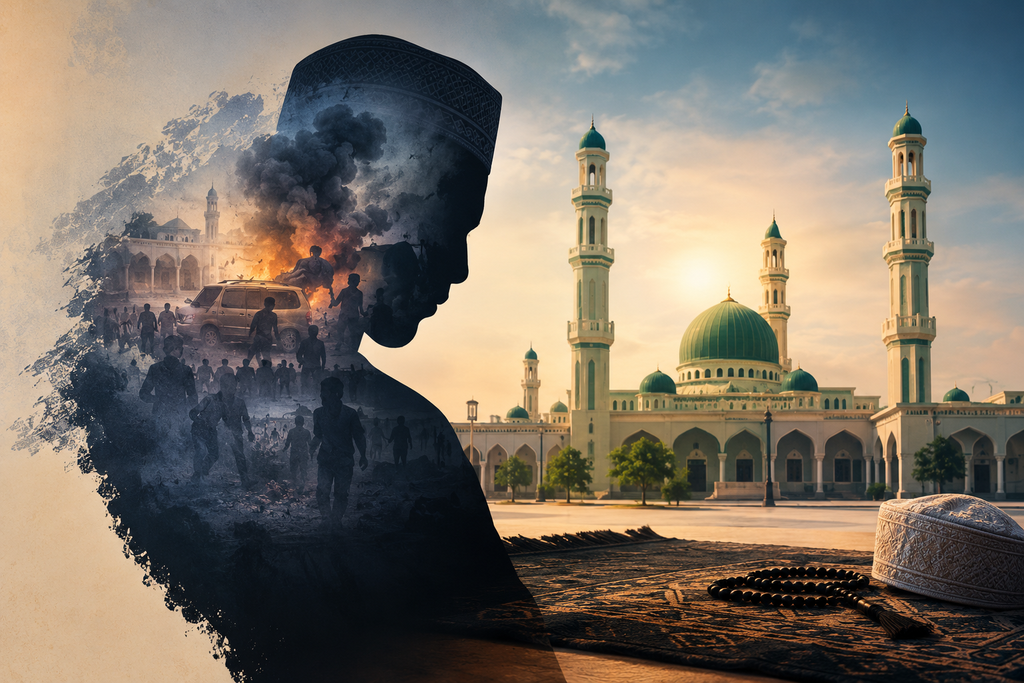
Physically, he was whole. Mentally, the blast was just beginning.
The Science of Unseen Scars
For weeks following the attack, Ayuba’s survival appeared complete to the outside world. Well-meaning friends and neighbors reminded him to be grateful that he had escaped unharmed. But inside, a different reality was taking hold. He withdrew entirely, spending five consecutive Fridays praying at home, unable to set foot inside a mosque.
“Inside me, I feel pain in my heart and fear,” Ayuba explained. “Physically, I am saved, but inside me, there is worry, fear, and trauma.”
To understand why an individual without a scratch can remain trapped in the terror of an event that occurred over a decade ago, one must examine the neurobiology of severe psychological shock.
“Trauma is a profound neurobiological response rather than a physical wound,” explains Dr. Lukhman of Aminu Kano Teaching Hospital, a mental health expert. “When an individual witnesses extreme, life-threatening horror such as a suicide bombing the brain’s fear centre, the amygdala, surges into maximum overdrive, flooding the body with stress hormones. In the intensity of that moment, the hippocampus fails to process and file the experience away as a past event. Consequently, the brain’s alarm system remains trapped in a perpetual state of hyper-vigilance. Even years later without a scratch on the body, the nervous system reacts as though the threat is active, manifesting as severe insomnia, chronic fear, and intrusive sensory memories.”
Dr. Lukhman’s analysis directly illuminates Ayuba’s ongoing struggle. For more than ten years, nightfall has brought no relief. Ayuba has suffered from chronic, agonising headaches and severe insomnia a common manifestation of a nervous system locked in a continuous state of high alert.
Although his family eventually took him to the Aminu Kano Teaching Hospital for specialised evaluation, and medical staff provided guidance to help him navigate his daily life, the internal weight has lingered.
“Up till today, more than ten years later, I have a burden in my heart, and the trauma has not gone,” Ayuba said.
The Burden of Remembering
There is another dimension to Tijjani’s ongoing challenge: the societal expectation that survivors should repeatedly recount their terror to satisfy public curiosity or journalistic anniversaries.
When asked what he wished the public understood about survivors without physical scars, Ayuba offered a clear warning: “Don’t remind them of the incident, and don’t keep asking them questions just to make them narrate their stories. All these would take them back.”
His words highlight a delicate ethical line for investigative reporting. While documenting human rights and public tragedies is essential for accountability and historical record, forcing survivors to revisit raw, unintegrated memories can cause re-traumatisation.
Ayuba does not ask for the tragedy to be erased from public memory. Rather, he asks for recognition that physical survival is not synonymous with full recovery and that non-physical wounds demand the same empathy, clinical intervention, and public support as physical injuries.
Framing True Recovery
As Kano commemorates the eleven anniversary of the Central Mosque attack, Tijjani’s testimony serves as a critical mirror for society, public health institutions, and humanitarian organisation policy.
In the immediate aftermath of mass violence, medical triage naturally prioritises emergency surgical care, burn management, and physical rehabilitation. But when relief efforts end at the boundary of what can be seen, thousands of survivors like Ayuba are left to navigate the neurobiological aftermath of trauma in isolation.
A damaged limb is visible; a hyper-vigilant nervous system is invisible. Yet both can derail a life with equal severity.
Mallam Ayuba’s body carried him away from the blast wave eleven years ago, but his mind remained behind in the smoke. True justice and holistic healthcare for victims of terrorism require an approach that treats the mind alongside the body ensuring that those who survive the explosion are not left alone to fight the war within.