By Hussaini Umar
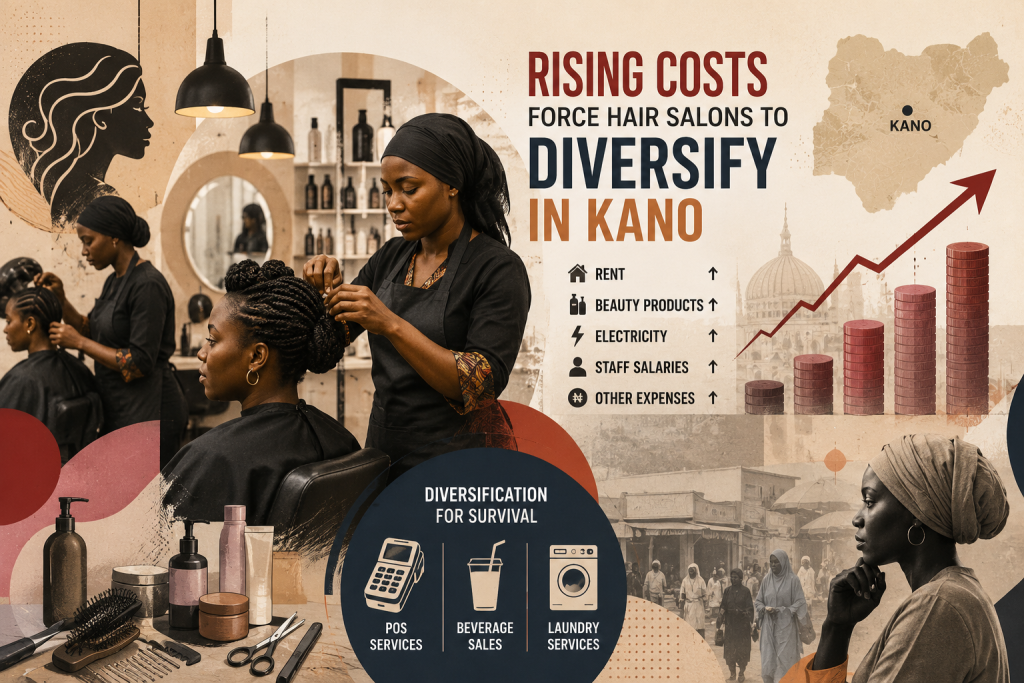
KANO, Nigeria — Hair salons across Kano are reinventing their business models as rising operating costs, declining consumer spending and changing customer behaviour reshape one of the city’s most vibrant small-business sectors.
Once known primarily for hair washing, styling, and colouring, many salons have transformed into full-service beauty centres offering spa treatments, manicures, pedicures, facials, waxing, henna design, and massage therapy. Increasingly, however, operators are also turning to entirely different income streams—including Point of Sale (POS) services, beverage sales, and laundry businesses—to remain financially viable.
The trend reflects the broader challenges confronting Nigeria’s small and medium-sized enterprises (SMEs), many of which are struggling with inflation, rising commercial rents, higher electricity costs, and increased prices for imported products.
A Beauty Industry Under Pressure
Hair salons have long served as more than places for personal grooming in Kano. They are important social spaces where women gather, exchange ideas, and access a range of beauty and wellness services.
Demand remains particularly strong during weekends, weddings, and religious festivities, when customers prepare for celebrations. Yet salon owners say increased patronage during peak periods no longer guarantees profitability.
Bilkisu Bello, a salon owner in the Kano metropolis, said the cost of maintaining a beauty business has risen sharply in recent years.
According to her, annual shop rent now exceeds ₦1 million, excluding staff salaries, electricity bills, and the rising cost of beauty products and equipment.
“After paying all the bills, I sometimes have to add money from other sources just to keep the business running,” she said.
Another salon operator, Hajara Bala, said the sector has changed significantly over the past few years.
She explained that many salon owners now combine beauty services with other small businesses to supplement their income.
“The high cost of professional salon services has forced many customers to patronise smaller neighbourhood salons that offer similar services at lower prices,” she said.
Consumers Are Also Changing
The economic pressures affecting salon owners are equally influencing customer behaviour.
As household budgets tighten, many women are reducing discretionary spending on beauty treatments or delaying salon visits altogether.
A Kano resident, Maimuna Said, said she now saves for several months before visiting a professional salon for specialised beauty services.
Another resident, Binta Shehu, said she increasingly washes and maintains her hair at home to reduce expenses.
These changing spending patterns mirror broader consumer responses to Nigeria’s cost-of-living pressures, with households prioritising essential needs while reducing expenditure on non-essential services.
Urban–Rural Divide
The survey also highlights disparities in access to professional beauty services between urban and rural communities.
Ladi Bala and Zainab Jibril, residents of Yan Dadi Ward in Tsanyawa Local Government Area, said they have never visited a hair salon because no such facility exists in their community.
According to them, professional beauty salons are generally regarded as services available mainly to urban residents and higher-income households, while women in rural communities continue to rely on traditional home-based grooming practices.
The contrast illustrates how access to personal care services remains uneven across Kano State, reflecting broader differences in infrastructure, income levels and business investment.
Diversification Becomes a Survival Strategy
Business analysts say the experience of Kano’s hair salons reflects a wider trend among Nigerian SMEs.
Rather than relying on a single source of revenue, many small businesses are diversifying their operations to spread risk and improve financial resilience.
Across urban centres, businesses that once specialised in one service increasingly combine retail sales, digital financial services, logistics or other complementary activities to offset rising operating costs.
For salon owners, diversification is becoming less of a growth strategy and more of a survival mechanism.
Data Unveiled Analysis
The challenges facing Kano’s beauty industry extend beyond hair care.
They illustrate how inflation and rising business costs are reshaping Nigeria’s informal and small-business economy.
As operating expenses continue to increase and consumer purchasing power weakens, entrepreneurs are being forced to innovate, diversify, and adapt in order to remain profitable.
Whether through expanding beauty services, introducing POS operations, or entering entirely new lines of business, Kano’s salon owners are demonstrating the resilience that characterises much of Nigeria’s SME sector.
Their experience also highlights a broader economic reality: when inflation persists, even businesses with loyal customers must rethink how they generate income.