Polio-Free, But Not Vaccine-Secure: Kano’s Immunisation Reckoning
Nearly two decades after a vaccine boycott that began here helped spread polio across a dozen countries, Kano holds an internationally certified polio-free status. It also still carries one of the largest populations of children in Nigeria who have never received a single routine vaccine.
In August 2021, a father named Baba Ali told the World Health Organisation he had spent years doubting the polio vaccine — until one of his own children woke up one morning with weakness in his legs. His son was three. He had polio. “I will henceforth not only allow my children to be vaccinated but will champion the drive to vaccinate other children in my village,” Ali said, from his home in Dawakin Kudu local government area. In the same account, a grandmother named Hajiya Sa’a described watching her 23-month-old grandson, Tanimu, become paralysed after his parents missed the rest of his vaccine schedule. Both stories were recorded by WHO field teams during an emergency vaccination drive that year — a drive made necessary by a new, vaccine-derived polio outbreak in a state that had already suffered through one of the worst chapters in the history of global immunisation.
That chapter began in Kano and rippled outward. Between mid-2003 and mid-2004, religious and political leaders in Kano and several other northern states suspended oral polio vaccination after rumours spread that the vaccine was a Western plot to spread HIV or sterilise Muslim girls — rumours that took root partly because of lingering anger over an unrelated, unauthorised Pfizer drug trial in Kano years earlier in which eleven children had died. The boycott lasted roughly eleven months. By the time it ended, the virus had re-established itself so firmly that it spread from Nigeria into more than a dozen previously polio-free countries. By 2008, Nigeria alone accounted for 86 per cent of all polio cases on the African continent.
How Kano got to zero
The path from boycott to certification took the better part of two decades and rested on a strategy that had little to do with vaccines themselves: rebuilding trust. Health authorities leaned on the same religious and traditional structures that had once resisted immunisation, engaging emirs and local clerics as advocates rather than treating them as obstacles. Surveillance was overhauled — acute flaccid paralysis case-finding was pushed above WHO’s benchmark sensitivity threshold, and technologies like GIS mapping and the AVADAR mobile alert system helped field teams find undervaccinated settlements they had previously missed entirely. By 2019, routine immunisation coverage exceeded 80 per cent in most of Kano’s local government areas, clearing the way for certification the following year.
The outbreak response that followed certification
Certification was not the finish line it looked like. Within months, a vaccine-derived strain — a rare but real risk in any place where routine coverage still has gaps — began circulating in Kano and seventeen other states. The state’s response, backed by the WHO, reached 3,297,347 children, 99 per cent of its target, in a single synchronised campaign carried out with three neighbouring states. It was, by any measure, a fast and disciplined operation. It was also a reminder that a polio-free certificate protects against one disease, not against the underlying weaknesses in routine immunisation that let outbreaks like this happen in the first place.
The children the system still isn’t reaching
Those underlying weaknesses show up most starkly in Kano’s zero-dose numbers. As of NPHCDA’s 2022 count, the state had 130,584 zero-dose children — those who have not received even the first dose of the basic diphtheria-tetanus-pertussis vaccine — making Kano home to roughly a quarter of every such child in Nigeria at the time. A more recent spatiotemporal analysis of national coverage data found that Borno had overtaken Kano in raw zero-dose numbers by 2024, but the two states, along with Katsina, Kaduna, Jigawa, Sokoto, Zamfara and Bauchi, remain consistently clustered at the top of the national burden.
Kano’s share of Nigeria’s zero-dose children
A qualitative study carried out across Kano’s health facilities in mid-2024, coordinated through the national zero-dose learning hub, traced the gap to a familiar set of problems: many primary health centres lean heavily on volunteer staff rather than trained health workers, cold-chain equipment fails often enough that vaccines are lost to temperature excursions and stock-outs, and some facilities simply don’t stock every antigen a child needs — the Hepatitis B birth dose came up repeatedly as one that’s often missing. Most facilities do have a stated strategy for finding zero-dose children in their catchment areas, the study found, but outreach sessions happen too rarely and don’t last long enough to catch families who are hard to reach in the first place.
Nigeria’s national DPT3 coverage, 2016–2023
The dip between 2021 and 2023 is the number worth sitting with. It shows a system that made real gains and then lost some of them — not because of a single dramatic failure, but because of exactly the kind of unglamorous, recurring problems the 2024 facility study documented: a cold chain that isn’t consistently maintained, a workforce stretched thin by volunteer dependence, and outreach sessions that don’t happen often enough to find every child before they age out of the window for a first dose.
What Kano is doing about it now
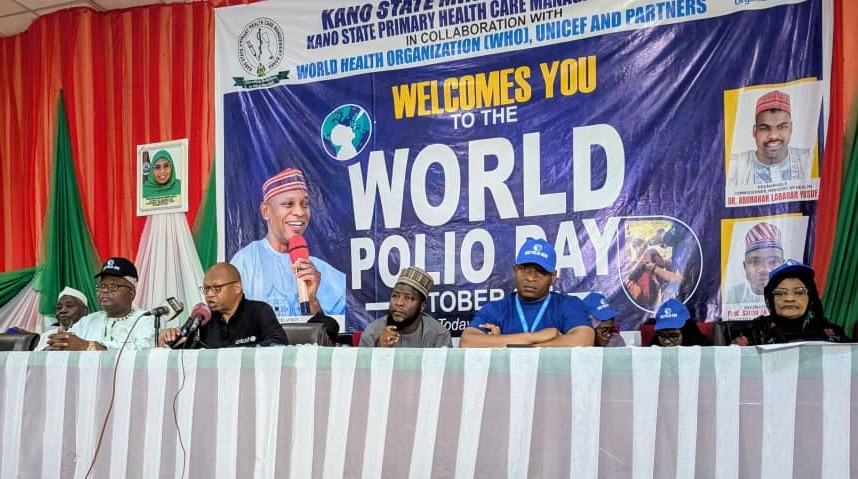
In June 2026, the Kano State Primary Health Care Management Board convened a Routine Immunisation Leadership Stocktake at the Emergency Operations Centre in Nassarawa Hospital, bringing health managers together to review programme data and confront the gaps directly. The meeting was chaired by the board’s Director General, Professor Salisu Ahmad Ibrahim, who used it to press frontline health workers and local government health authorities to keep working together on the fixes the meeting agreed on.
The board reaffirmed its dedication to ensuring equitable access to vaccines for every eligible child in the state, and urged programme managers and frontline workers to sustain collaboration in implementing the resolutions. — Prof. Salisu Ahmad Ibrahim, Director General, Kano State Primary Health Care Management Board, June 2026
The resolutions that came out of that meeting read like a direct answer to the 2024 facility study: better data management and reporting, stronger supportive supervision, sustained cold-chain maintenance, expanded outreach sessions, and more disciplined use of Basic Health Care Provision Fund resources specifically for immunisation. The board also flagged Human Papillomavirus vaccination as a priority alongside the traditional childhood schedule — an acknowledgment that routine immunisation in Kano now has to stretch further than it did even five years ago.
None of this is a guarantee. Kano’s own history is proof that immunisation gains can be undone by a single season of mistrust, and its own recent data is proof that gains can quietly erode even without a dramatic boycott — just a missed outreach visit, an empty vaccine fridge, a health post with no one trained to staff it. What the state has now, that it didn’t have in 2003, is two decades of hard-won knowledge about what actually rebuilds trust and coverage: engaging the same community leaders who once led the resistance, tracking data closely enough to catch a slide before it becomes a crisis, and treating every zero-dose child not as a statistic but as one more version of Tanimu — a name, a ward, a missed appointment that a health worker can still go back and fix.
Baba Ali says he has kept his promise. He tells his neighbours in Dawakin Kudu what happened to his son, and he pushes the families in his settlement who still hold back to reconsider before it’s too late for them too.
- WHO Regional Office for Africa — Kano outbreak response field report, August 2021
- NPHCDA — Zero-dose children count, 2022; National Routine Immunisation Strategic Plan
- PMC / Frontiers in Public Health — Kano polio pre-certification case report
- PMC — Decentralized Immunization Monitoring, Kumbotso LGA pilot, Kano State
- DRPC / Zero-Dose Learning Hub — Kano facility-level qualitative study, 2024
- medRxiv — spatiotemporal mapping of zero-dose prevalence in Nigeria, 2000–2024
- Tribune Online — Kano Routine Immunisation Leadership Stocktake report, June 2026
- PLOS Medicine / PMC — accounts of the 2003–2004 Nigerian polio vaccine boycott
- Wikipedia — polio eradication timeline, cross-checked against primary reporting above