By Hamza Muhammad Uba | Data Analysis by Hussaini Umar February 11, 2026
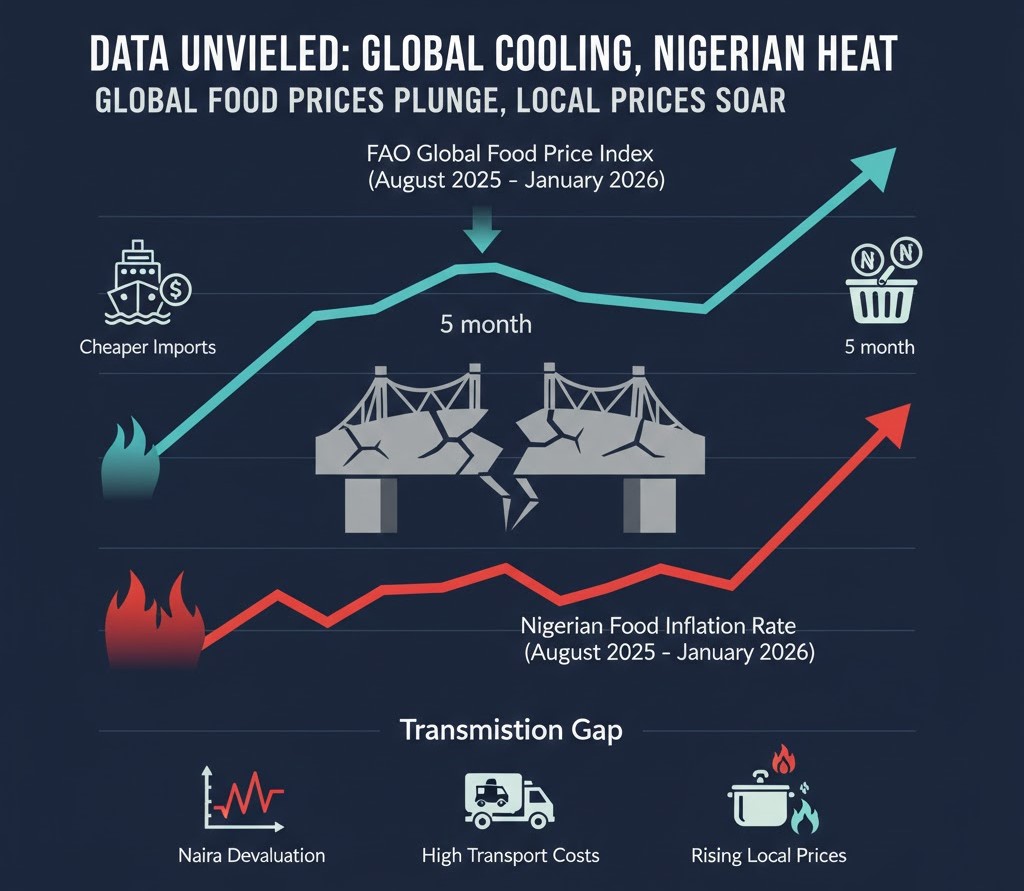
The world is witnessing a rare period of “macro-relief.” According to the latest United Nations Food and Agriculture Organization (FAO) Food Price Index, global food prices declined in January 2026 for the fifth consecutive month. While this marks a significant recalibration of the global supply chain, for the average consumer in Kano or Lagos, the “household kitchen economy” remains under pressure.
The Data: A 5-Month Cooling Trend
The FAO Index, which tracks a basket of commonly traded food commodities, shows that the “cost-of-living” crisis is easing at the source. This trend is driven by three primary factors:
- Bumper Harvests: Improved wheat and maize yields in the southern hemisphere.
- Vegetable Oil Recovery: Multi-month lows in palm and sunflower oil prices as Southeast Asian and Black Sea logistics stabilize.
- Logistics Recalibration: Improved grain corridor efficiency despite ongoing regional tensions.
| Commodity Index | Trend | Primary Driver |
| Cereals (Wheat/Maize) | Sharp Decline | Favorable weather in exporting regions. |
| Vegetable Oils | Multi-month Low | Surge in palm oil production. |
| Sugar & Dairy | Marginal Dip | Seasonal demand cooling. |
| Overall Index | 5-Month Drop | Calibration of global supply chains. |
The ‘Transmission Gap’: Why Local Prices Stay High
As a data journalist, I look at the “Micro-Macro Mismatch.” While the FAO report serves as a “macro-stabilizer” for central banks, emerging economies like Nigeria face three “inflationary buffers” that block the benefits of cheaper imports:
- Currency Volatility: The “Naira-to-Dollar” exchange rate often negates any drop in the international price of wheat or sugar. Even if the global price falls by 5%, a dip in currency value can make the final import more expensive.
- Inland Transportation Costs: The high cost of diesel and the “infrastructure of distribution” (road networks and port surcharges) add a massive markup between the port and the local retail market.
- Energy Costs: Processing food locally requires power. High energy costs act as a “floor” that keeps retail prices high even when raw materials are cheaper.
Strategic Opportunity for Nigeria
The current downward trend provides a “window of opportunity” for Nigeria’s policymakers. With global prices lower, this is the strategic moment to:
- Build Strategic Reserves: Stockpiling grains while international prices are low to stabilize the domestic “food security” index.
- Infrastructure Investment: Optimizing the logistics of transit (like the Onne and Lagos ports) to ensure that “macro-relief” actually reaches the “micro-economy.”
- Agribusiness Margins: For local manufacturers using sugar and dairy, lower raw material costs offer a chance to improve margins or stimulate consumer demand through price adjustments.
The Bottom Line for 2026
The FAO report suggests a period of relative stability for the first quarter of 2026. However, with El Niño weather patterns posing a risk to future rice harvests and maritime risks in the Red Sea remaining high, this relief is fragile. For Nigeria to turn this global trend into a local win, the focus must shift from the “price of the commodity” to the “efficiency of the system.”
Data Perspective: This analysis is grounded in the FAO January 2026 Food Price Index and current Nigerian macroeconomic indicators. The “transmission of relief” remains the most critical metric for the first half of the year.